

Time: 2026-11-05 Views:
Most retail hardware budgets still land on the checkout counter. The losses accumulate several metres behind it, on the dock and in the aisle. Closing that gap takes three device roles working on the same record, not one better POS.
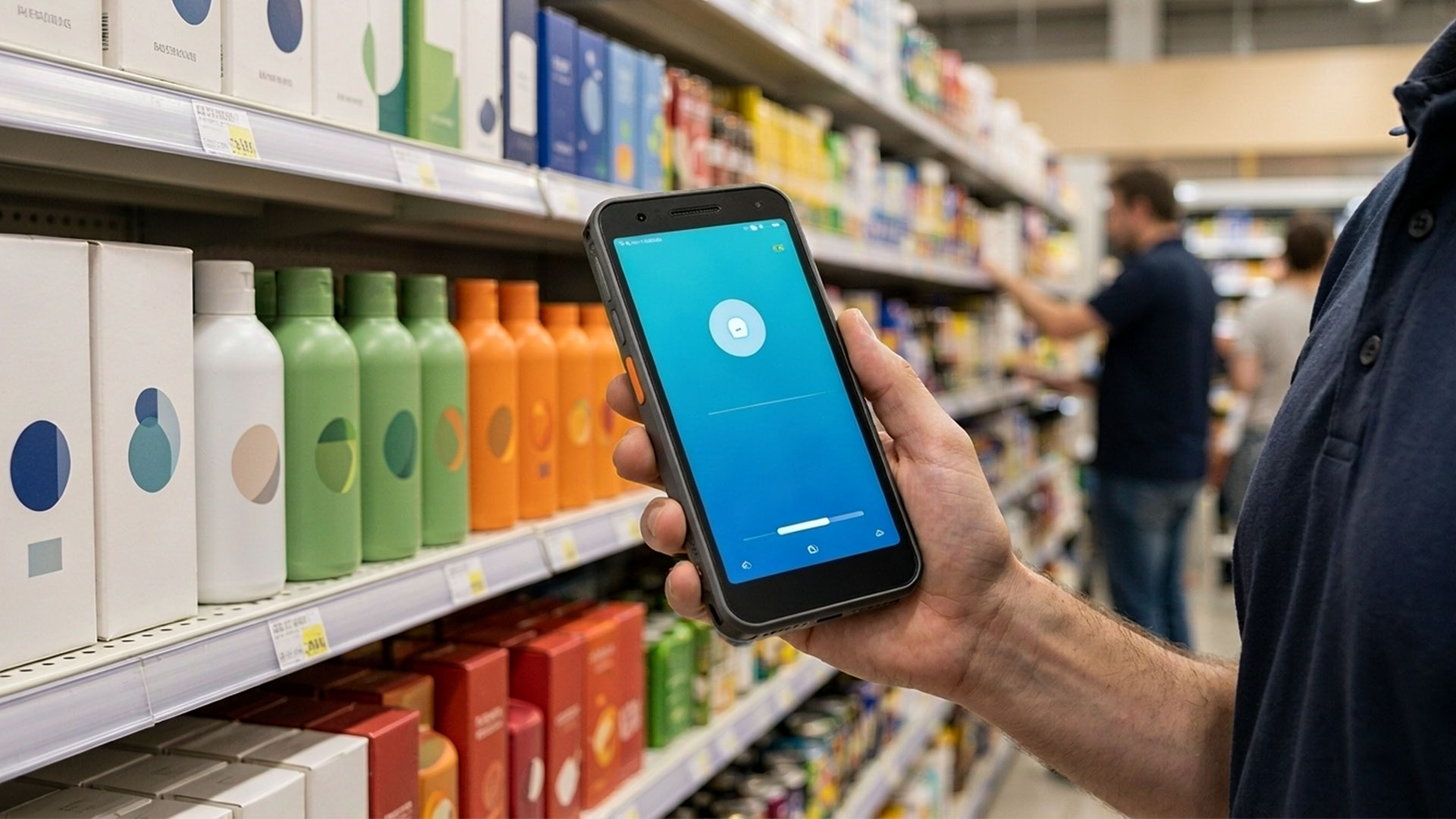
Most retail technology budgets still land on the checkout counter. The money leaks further back, on the dock where a pallet is signed in against a delivery note, and in the aisle where the shelf label and the stock record quietly disagree with each other.
IHL Group's 2025 Shelf Intelligence Report puts numbers on that disagreement. Among US retailers with annual revenue above USD 500 million, self-reported on-shelf availability averaged 58 per cent, planogram compliance 57 per cent and promotional compliance 60 per cent. Only 22 per cent of those retailers reached 80 per cent on any single shelf metric. The same study estimates that mismatches between system records and shelf reality cost retail roughly 5 per cent of global revenue, about USD 1.7 trillion.
The gap is not one event. It is the sum of thousands of small readings that never happened. A carton counted by the pallet instead of the unit. A case shelved one bay over. A count postponed because the store could not spare two people for a night shift.
A store day runs through five handovers, and every one of them depends on a device doing something inside a second.
Receiving. The truck arrives at 06:40, the delivery note says 24 cartons, and someone with a clipboard confirms 24 before the driver leaves. Whether each carton contains the units the purchase order expects is a different question, usually answered three days later.
Replenishment. A gap on the shelf gets filled when someone notices it. Between the noticing and the filling there is a decision nobody records: was the item in the back, in transit, or never delivered?
Shelf maintenance. Price changes, promotions, planogram resets. Each is an instruction from head office that has to become a physical action on a specific bay, verified by someone.
Counting. The count is the only step that produces a number the business trusts, and it is also the step most often rescheduled.
Checkout. This is where every earlier failure finally reaches a customer, in the form of a price that does not match the label or an item that cannot be found in the back.
None of these steps is complicated. They fail because they compete for the same labour hours, and a store will always choose the customer over the count.
Receiving is measured by the pallet, not by the unit. A delivery is confirmed at carton level because unit-level verification at the dock takes longer than the truck is willing to wait. The discrepancy then sits in the system as credible inventory until a customer asks for it.
Replenishment runs on a gap nobody has measured. Staff replenish what looks empty. Slow-moving stock that is present but misplaced reads as available, so the system never flags it and the shelf never refills.
Counting collapses under its own labour cost. The same IHL study found that 67 per cent of retailers have inventory problems weekly or daily, and 88 per cent want counts weekly or more often, with nearly half wanting several times a week or daily. Manual counting cannot deliver that frequency, because the cost scales linearly with the number of SKUs and the number of checks.
Checkout is where errors surface last. By the time a cashier discovers the shelf is empty, the sale is already at risk and the customer is already disappointed. The correction happens after the revenue is lost.
The pattern is consistent: the record degrades fastest exactly where capture is manual, and the store finds out at the worst possible moment.
The answer is not a better terminal at the counter. It is three device roles, each matched to what happens at that point in the journey, all writing to the same record.
The counting device is the one that determines whether a count is worth doing at all. A handheld that requires a worker to align a barcode on every unit limits you to sample counts, because a full pass would take the night shift.
The DT610 Pro carries an integrated UHF RFID module reading EPC Class 1 Gen 2 / ISO 18000-6C tags at up to 1.2 metres and 50 tags per second, across both 865–868 MHz and 902–928 MHz bands. For deeper aisles and pallet-level reads, an RFG91 gun attachment extends that to 15 metres.
The rest of the specification is what makes the device usable for a full shift rather than a demonstration: a 6.0-inch 1080×2160 display at 600 nits for reading in bright aisles, IP68 sealing with 1.8-metre drop resistance, an operating range of −20°C to 60°C, and a removable 5,200mAh pack that supports a hot swap in 60 seconds. Connectivity runs on Wi-Fi 7 across 2.4, 5 and 6 GHz with 2×2 MU-MIMO, plus 5G and Bluetooth 6.0, on Android 15 with an upgrade path to Android 19.

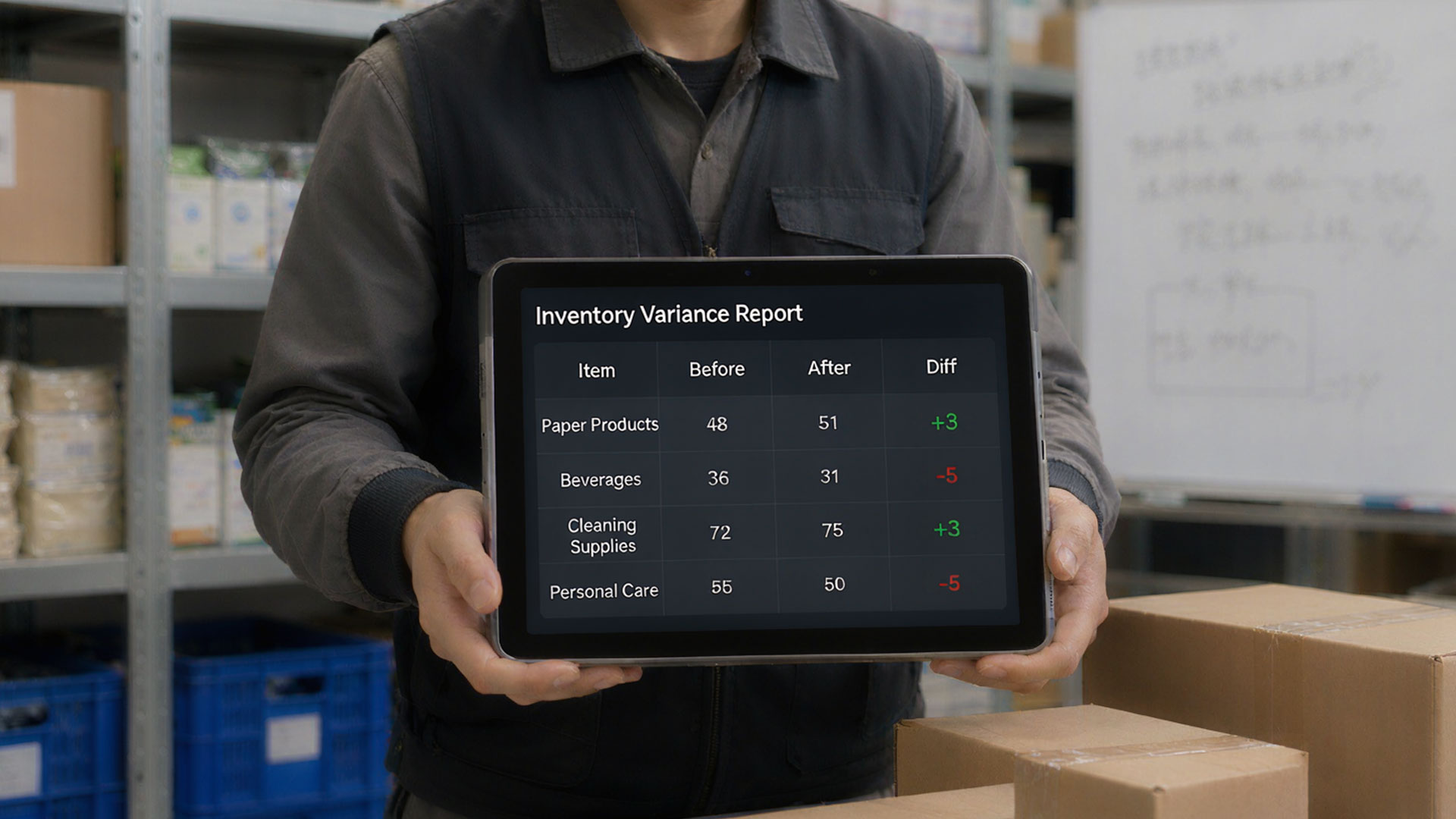
Between the aisle and the counter sits the work that decides tomorrow: reviewing variances, re-sequencing replenishment, checking a delivery against its purchase order, printing or reprinting labels.
A 6-inch handheld is the wrong tool for that work. The UPad offers an 11-inch 1920×1200 WUXGA panel at 450 nits, so a stock variance list or a store floor plan is readable without scrolling sideways. It combines three capture modes in one chassis — standard-range or optional FlexRange 1D/2D scanning, built-in UHF RFID at up to 1.5 metres and 50 tags per second, and NFC with HCE card emulation that is CPoC compliant, which means the same tablet can take a payment at a pop-up or a queue-busting position.
At 500 grams, it can be carried to the shelf rather than only used at a desk. An 8,000mAh battery with AI-managed charging, IP54 sealing and 1.2-metre drop resistance match it to back-of-house conditions rather than an office. Wireless covers Wi-Fi 6E with 2×2 MU-MIMO and optional Wi-Fi HaLow, on Android 16 with an upgrade path to Android 20.
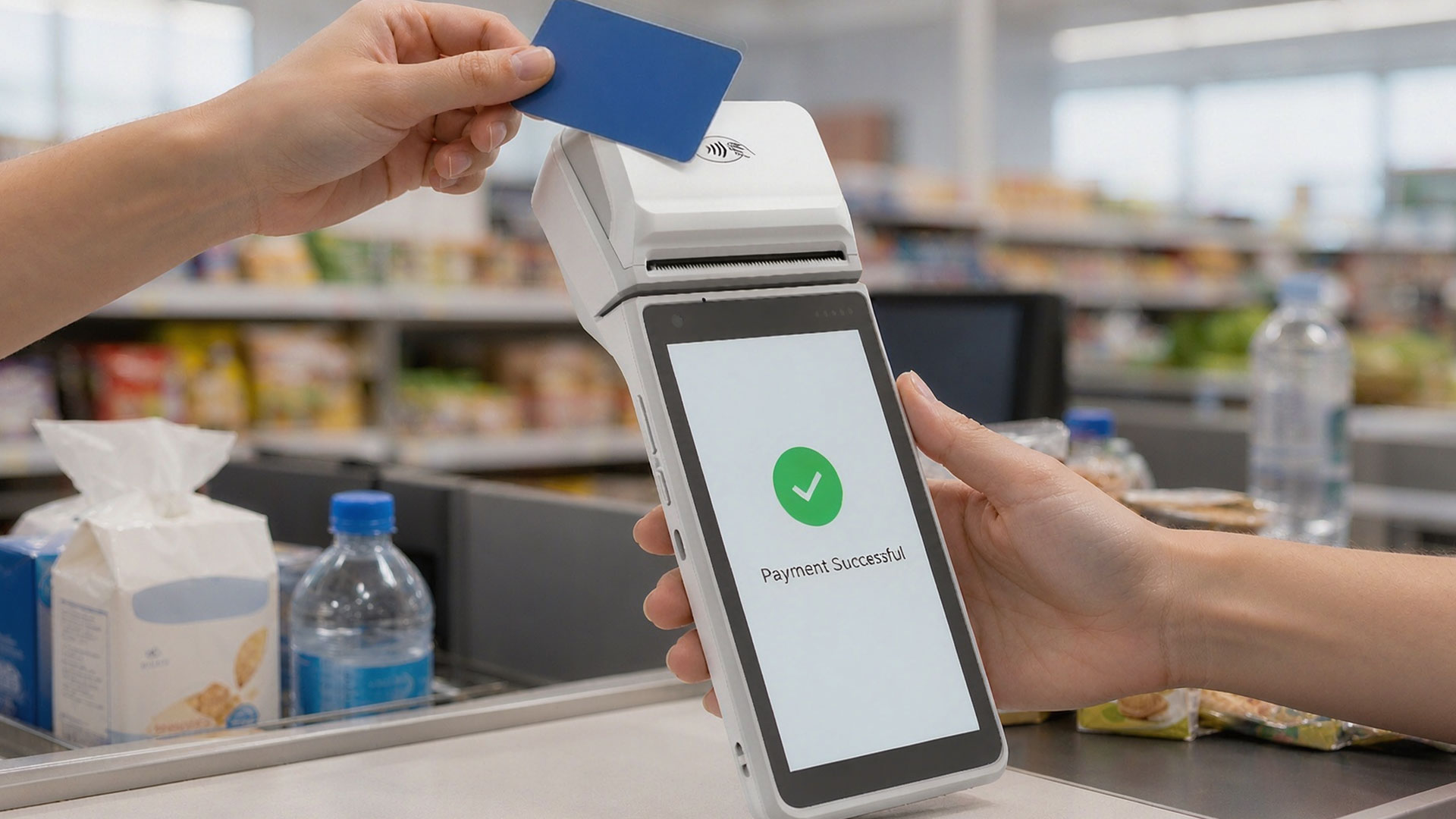
The counter is where the record gets spent. A checkout terminal that cannot read what the aisle produced simply moves the error one step closer to the customer.
The i9200 carries the full payment certification set — PCI PTS 6.x, EMV Level 1 and Level 2, EMV Contactless Level 1, Visa payWave and Mastercard Contactless — across magnetic stripe, IC card and contactless, with a 5.5-inch 720×1440 display and a removable 5,000mAh battery. Two SAM slots sit alongside either dual SIM or an eSIM configuration, which is what allows loyalty, tax and payment applications to coexist on one counter instead of forcing a second terminal into the drawer.
It is the model positioned for fleet-wide rollout rather than a flagship pilot: the same certification depth, a compact 363-gram body at 18.5 mm at its thinnest, and a configuration range that suits dozens of counters in a chain.
Reading range sets the counting frequency you can actually afford. Moving from unit-by-unit scanning to bulk RFID reads changes a count from a night shift into an aisle walk. That is the physical precondition for the weekly cadence most retailers say they want.
Radio behaviour decides whether the record updates in real time. Back rooms, chilled zones and metal shelving are where wireless drops. Wi-Fi 7 with 2×2 MU-MIMO across three bands, backed by 5G, keeps a scan event a live record instead of a batch file uploaded at closing.
Power architecture decides whether the fleet survives three shifts. A sealed battery turns a handheld into a fixed station tethered to a socket. A removable pack with a 60-second hot swap keeps the device in the aisle.
Sealing decides which zones the fleet can enter. Cold rooms, loading docks and open yards are part of the same store. IP68, 1.8-metre drop resistance and a −20°C to 60°C range mean one device specification covers all of them.
Accessory continuity decides whether a rollout stays affordable. The DT610 Pro shares its RFG91 gun, charging cradles and battery chargers with the DT610 generation, so a mixed fleet does not need a second accessory ecosystem.
The targets below are reference benchmarks for a retail operation that has closed the capture gap. They are not measured results from a specific deployment, and a store starting from quarterly counts should expect a staged improvement rather than an overnight one.
Measure the wireless before you specify the device. Wi-Fi 7 capability only pays off where access points support it. Where they do not, the device falls back and the real-time promise weakens. A site survey per store format is cheaper than a fleet-wide surprise.
Decide the tag layer first. Item-level, case-level, shelf-edge and pallet-level tagging produce very different read behaviour. The tag decision determines whether 1.2 metres is enough or whether the 15-metre gun becomes the primary tool.
Sequence the rollout by pain, not by department. Most operations get further by fixing counting first, then receiving, then checkout. Counting produces the fastest visible change and builds the internal case for the rest.
Plan the power, not just the battery. Hot swap only works if charged packs and charging cradles are where the shift change happens. A 5-slot cradle per store is a smaller line item than the downtime it prevents.
Keep one record owner. Three device roles only help if they write to the same inventory record. If the aisle count, the back-office review and the counter all update different systems, the gap simply moves.
Retail has spent two decades digitising the transaction. The record that the transaction depends on is still assembled by hand, in the aisle, at the moment nobody is watching. Closing that gap is not a checkout upgrade. It is a decision about which device reads the shelf, which device reviews the variance, and which device settles the sale — and whether all three are describing the same store.
Talk to our team about mapping those three roles against your store formats and counting cadence.
Tell us how many stores you run, how often you count today and where the record breaks first. We will map the three device roles against your floor plan.
Talk to our team +86-13827760889
 info@wepoy.com


Our Products

Industries
About Us